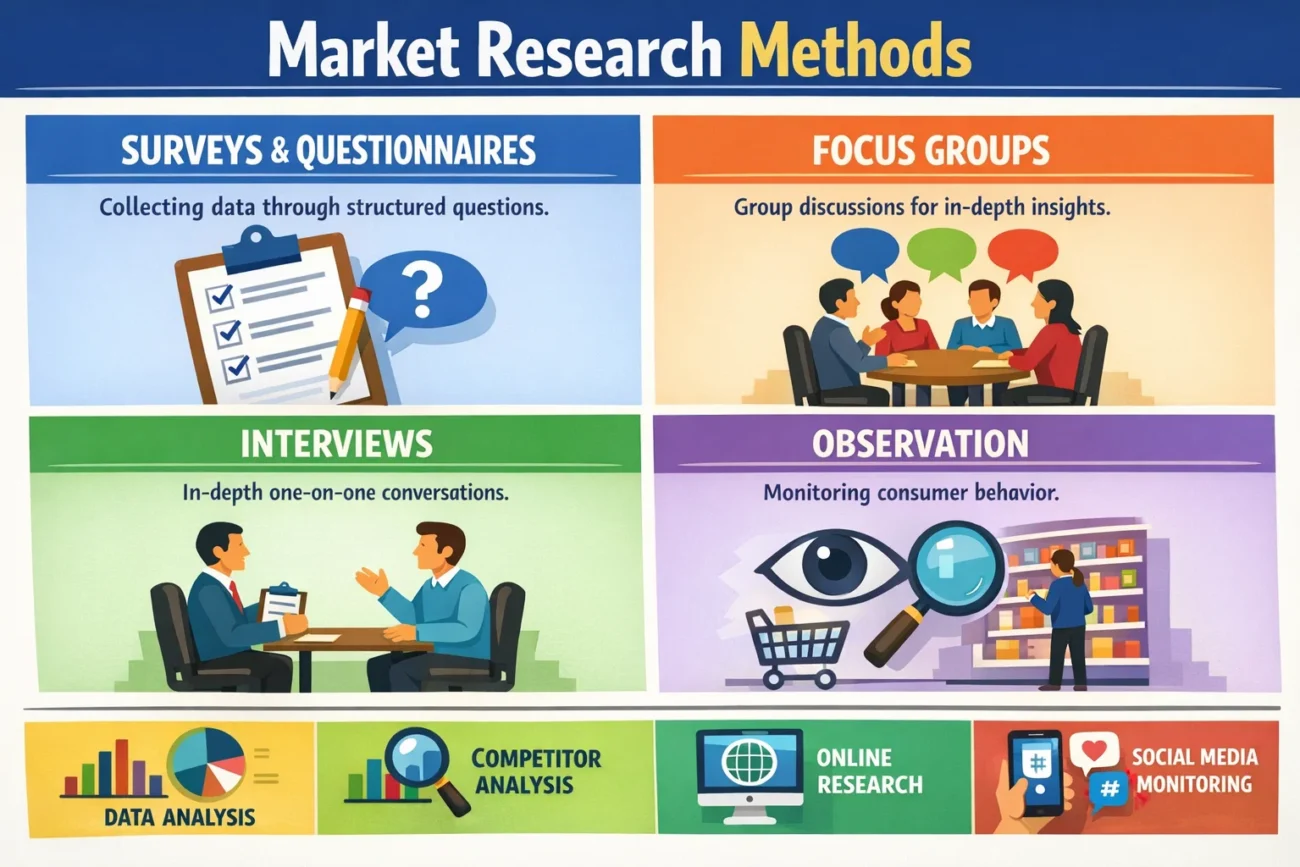
Introduction to Market Research Methods
Market research methods are systematic approaches used by businesses, organizations, and researchers to gather, analyze, and interpret data about markets, customers, competitors, and industry trends. These methods play a crucial role in decision-making, enabling companies to reduce risk, understand consumer needs, and identify new opportunities.
In an increasingly competitive and data-driven world, effective market research methods allow businesses to move beyond assumptions and base their strategies on real insights. Whether a company is launching a new product, entering a new market, or refining an existing service, market research methods provide the foundation for informed and confident actions.
The Importance of Market Research in Business Strategy
Market research methods are essential because they connect businesses directly with their target audience. Without research, companies rely on guesswork, which can lead to costly mistakes. By applying structured research methods, businesses can identify customer preferences, buying behaviors, pain points, and unmet needs.
This information supports strategic planning, product development, pricing decisions, branding, and promotional activities. Market research methods also help organizations stay agile by monitoring changing market conditions and adapting quickly to shifts in consumer behavior or competitive landscapes.
Primary and Secondary Market Research Methods
Market research methods are broadly divided into primary and secondary research. Primary research involves collecting original data directly from sources such as customers, prospects, or industry experts. Secondary research, on the other hand, relies on existing data that has already been collected and published by other organizations. Both approaches have unique advantages and limitations, and effective market research strategies often combine primary and secondary methods to gain a comprehensive understanding of the market.
Primary Market Research Methods Explained
Primary market research methods focus on gathering firsthand information tailored to specific research objectives. These methods are especially valuable when businesses need detailed, customized insights that are not available through existing sources. Primary research allows organizations to ask targeted questions, explore specific issues, and gain a deeper qualitative and quantitative understanding. Although primary research can be time-consuming and costly, the accuracy and relevance of the data often justify the investment.
Surveys as a Core Market Research Method
Surveys are one of the most widely used market research methods due to their versatility and scalability. They involve asking a series of structured questions to a sample of respondents through online platforms, email, phone, or face-to-face interactions. Surveys are particularly effective for collecting quantitative data, such as customer satisfaction levels, brand awareness, and purchasing habits.
Well-designed surveys allow businesses to analyze trends, compare responses across segments, and make data-driven decisions. However, survey quality depends heavily on question clarity, sample selection, and response rates.
Interviews for In-Depth Market Insights
Interviews are qualitative market research methods that involve one-on-one conversations between researchers and participants. These methods provide deep insights into customer motivations, attitudes, and perceptions that cannot always be captured through surveys. Interviews can be structured, semi-structured, or unstructured, depending on the research goals.
Because they allow for follow-up questions and open-ended discussions, interviews are ideal for exploring complex topics, understanding emotional drivers, and uncovering hidden issues that influence consumer behavior.
Focus Groups and Group Discussions
Focus groups are interactive market research methods that bring together a small group of participants to discuss a product, service, or concept. Guided by a moderator, focus groups encourage participants to share opinions, react to ideas, and build on each other’s responses. This method is particularly useful for exploring brand perceptions, testing marketing messages, and evaluating product features. Focus groups offer rich qualitative data, but they must be carefully managed to avoid groupthink or dominant participants influencing the discussion.
Observation-Based Market Research Methods
Observation is a market research method that involves watching how consumers behave in real-life or controlled environments. Rather than relying on what people say, observation focuses on what they actually do. This method is especially useful in retail, usability testing, and consumer behavior studies.
Observational research can reveal insights about shopping patterns, product usage, and decision-making processes that consumers may not consciously articulate. While observation provides valuable behavioral data, it often needs to be combined with other methods to understand underlying motivations.
Experimental and Test-Based Research Methods
Experimental market research methods involve manipulating variables to observe their impact on consumer behavior. Common examples include A/B testing, test marketing, and controlled experiments. These methods are widely used in digital marketing, pricing strategies, and product development.
By comparing different versions of a product, advertisement, or website, businesses can determine which option performs best. Experimental research offers high reliability because it establishes cause-and-effect relationships, making it a powerful tool for optimizing marketing efforts.
Secondary Market Research Methods Overview
Secondary market research methods rely on existing data sources such as industry reports, government publications, academic studies, and market analyses. These methods are cost-effective and time-efficient, making them ideal for gaining a broad understanding of the market. Secondary research helps businesses identify trends, benchmark performance, and assess market size and growth potential. While secondary data may not always be perfectly aligned with specific research needs, it provides valuable context and background information.
Using Industry Reports and Market Studies
Industry reports are widely used secondary market research methods that provide detailed insights into specific sectors. These reports often include data on market size, growth rates, key players, consumer trends, and future forecasts. Businesses use industry reports to evaluate competitive environments and identify opportunities or threats. Although high-quality industry reports can be expensive, they save time and offer professionally analyzed data that supports strategic decision-making.
Government and Public Data Sources
Government databases are reliable secondary market research methods that offer a wealth of information on demographics, economic indicators, employment trends, and consumer spending. Census data, labor statistics, and trade reports are commonly used by businesses to understand target markets and regional dynamics. Public data sources are often free and credible, making them valuable for foundational research. However, businesses may need to supplement government data with primary research for more specific insights.
Online and Digital Market Research Methods
Digital technologies have transformed market research methods by enabling faster data collection and real-time analysis. Online research methods include web analytics, social media monitoring, online surveys, and customer feedback platforms. These methods allow businesses to track user behavior, engagement, and sentiment across digital channels. Digital market research methods are especially useful for understanding online customer journeys and measuring the effectiveness of digital marketing campaigns.
Social Media as a Market Research Tool
Social media platforms have become powerful market research methods for understanding consumer opinions and trends. By analyzing comments, shares, likes, and mentions, businesses can gain insights into customer sentiment and brand perception. Social listening tools help organizations monitor conversations and identify emerging issues or opportunities. While social media data is vast and unfiltered, it requires careful analysis to separate meaningful insights from noise.
Quantitative vs Qualitative Market Research Methods
Market research methods are often categorized as quantitative or qualitative. Quantitative methods focus on numerical data and statistical analysis, making them ideal for measuring trends, patterns, and relationships. Qualitative methods emphasize depth and context, providing insights into thoughts, emotions, and motivations. Both approaches are complementary, and effective market research strategies often integrate quantitative and qualitative methods to achieve a balanced understanding.
Choosing the Right Market Research Methods
Selecting appropriate market research methods depends on research objectives, budget, timeline, and target audience. Exploratory research may benefit from qualitative methods like interviews and focus groups, while descriptive research often relies on surveys and secondary data. Businesses must also consider sample size, data accuracy, and ethical considerations. A clear research plan ensures that chosen methods align with goals and deliver actionable insights.
Challenges in Market Research Methods
Despite their value, market research methods face several challenges. Common issues include biased samples, low response rates, inaccurate data, and misinterpretation of results. Rapidly changing markets and consumer behaviors can also make research findings quickly outdated. To overcome these challenges, businesses must design research carefully, use multiple methods, and continuously update their data sources.
Ethical Considerations in Market Research
Ethics play a crucial role in market research methods. Researchers must ensure participant confidentiality, obtain informed consent, and avoid deceptive practices. Ethical research builds trust with consumers and protects brand reputation. Compliance with data protection regulations and ethical guidelines is essential, especially when handling personal or sensitive information.
The Role of Technology in Modern Market Research
Advancements in technology have significantly enhanced market research methods. Artificial intelligence, big data analytics, and automation tools allow researchers to process large volumes of data quickly and accurately. Predictive analytics and machine learning help businesses anticipate customer needs and market trends. Technology-driven market research methods improve efficiency and enable deeper insights, making research more strategic and impactful.
Market Research Methods for Startups and Small Businesses
For startups and small businesses, market research methods must be cost-effective and practical. Online surveys, customer interviews, and secondary research are commonly used due to limited budgets. Even simple research methods can provide valuable insights when applied strategically. Market research helps small businesses validate ideas, understand customer needs, and compete more effectively with larger organizations.
Future Trends in Market Research Methods
Market research methods continue to evolve as consumer behavior and technology change. Increasing use of artificial intelligence, real-time data collection, and personalized research approaches are shaping the future of the field. Mobile research, voice-based surveys, and immersive technologies such as virtual reality are emerging as innovative methods. These trends are making market research more dynamic, responsive, and customer-centric.
Conclusion
Market research methods are essential tools for understanding markets, customers, and competition. By combining primary and secondary research, qualitative and quantitative approaches, and traditional and digital methods, businesses can make informed decisions and reduce uncertainty.
In a rapidly changing business environment, effective market research methods provide clarity, direction, and a competitive edge. Organizations that invest in robust research practices are better positioned to innovate, grow, and succeed in the long term.
You May Also Read Here: Dodgers vs Arizona Diamondbacks match player stats
